
The legacy system suffered from tight coupling, long release cycles, and manual deployment bottlenecks that caused frequent downtime. To solve this, I designed a decoupled microservices architecture utilizing containerization (Docker/Kubernetes). I implemented Infrastructure as Code (IaC) using Terraform to standardize our environments and established automated CI/CD pipelines via Azure DevOps to remove manual dependencies and enforce strict quality gates.

Enterprise Cloud Migration & CI/CD Optimization.
Executive Summary
Spearheaded the migration of a monolithic enterprise application to a microservices-based cloud architecture. Modernized the deployment lifecycle, enabling zero-downtime releases and significantly improving system scalability for high-volume enterprise clients.
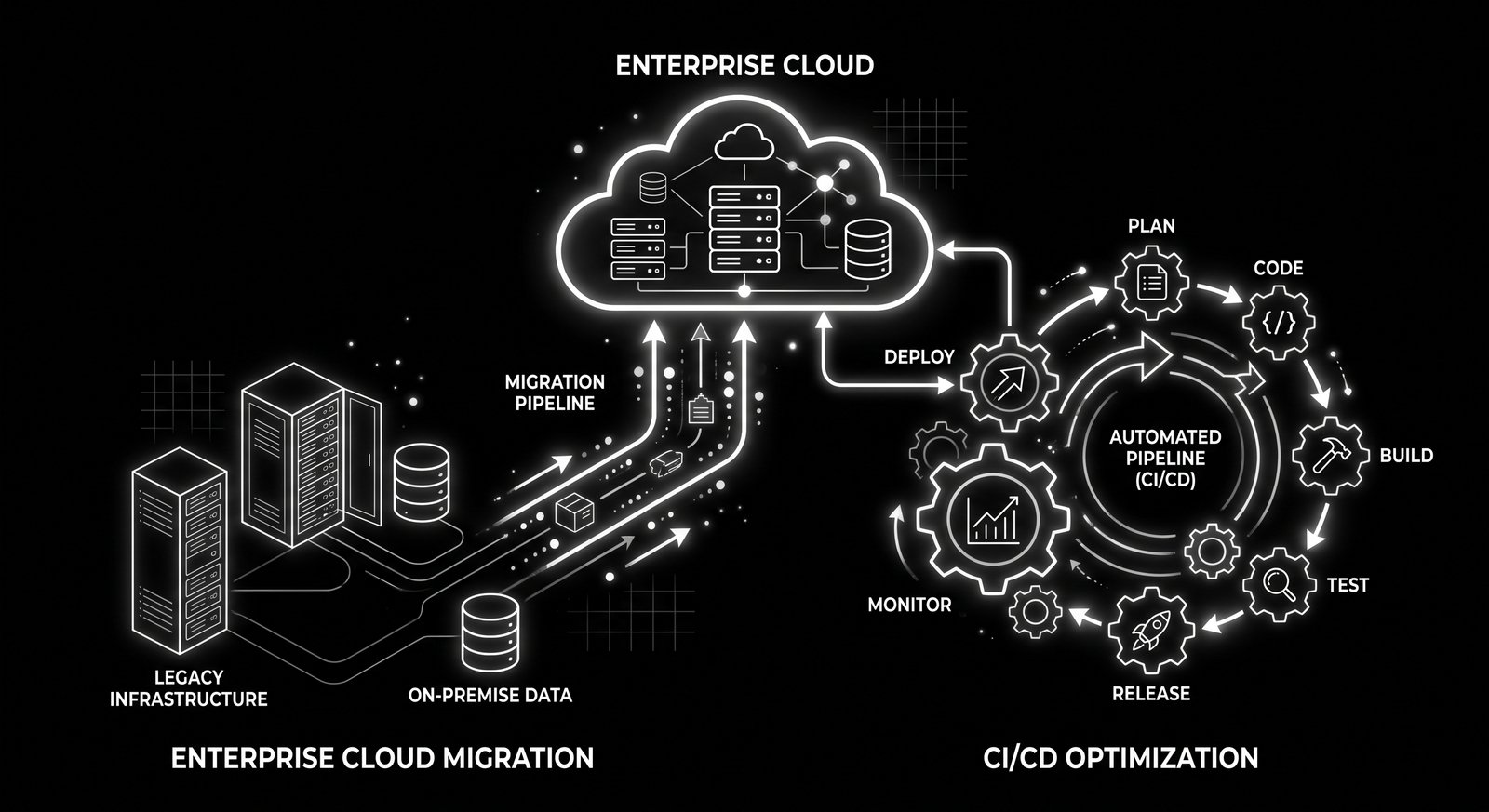
The Challenge & Architecture
Execution & Business Impact
Reduced deployment time by 75% and achieved 99.99% system uptime. By integrating automated testing into the pipeline, we cut post-release defects by 40%. Ultimately, the new cloud-native infrastructure reduced operational hosting costs by 20% while allowing the platform to scale dynamically during peak enterprise usage.
Enterprise Cloud Migration & CI/CD Optimization
Spearheaded the migration of a monolithic enterprise application to a microservices-based cloud architecture. Modernized the deployment lifecycle, enabling zero-downtime releases and significantly improving system scalability for high-volume enterprise clients.