

The Rise of Agentic Process Automation
For years, “automation” meant Robotic Process Automation (RPA)—a digital train on fixed tracks, perfect for repetitive tasks but easily derailed by the slightest change in data. In 2026, the tracks have been replaced by GPS-guided systems. We have officially entered the era of Agentic Process Automation.
From Assistive to Autonomous
The shift from 2025 to 2026 has been defined by a move away from “Co-pilots” toward “Autonomous Agents.” While a co-pilot waits for your command, an agent understands a high-level goal, plans the necessary steps, and executes them independently.
- Reactive vs. Proactive: Traditional automation waits for a trigger. Modern agents monitor real-time data streams and act before a problem even reaches a human inbox.
- Static vs. Adaptive: When a vendor changes an invoice format, old RPA would break. Today’s agentic systems use multimodal AI to “see” the document, interpret the change, and continue processing without a hiccup.
The Digital Assembly Line
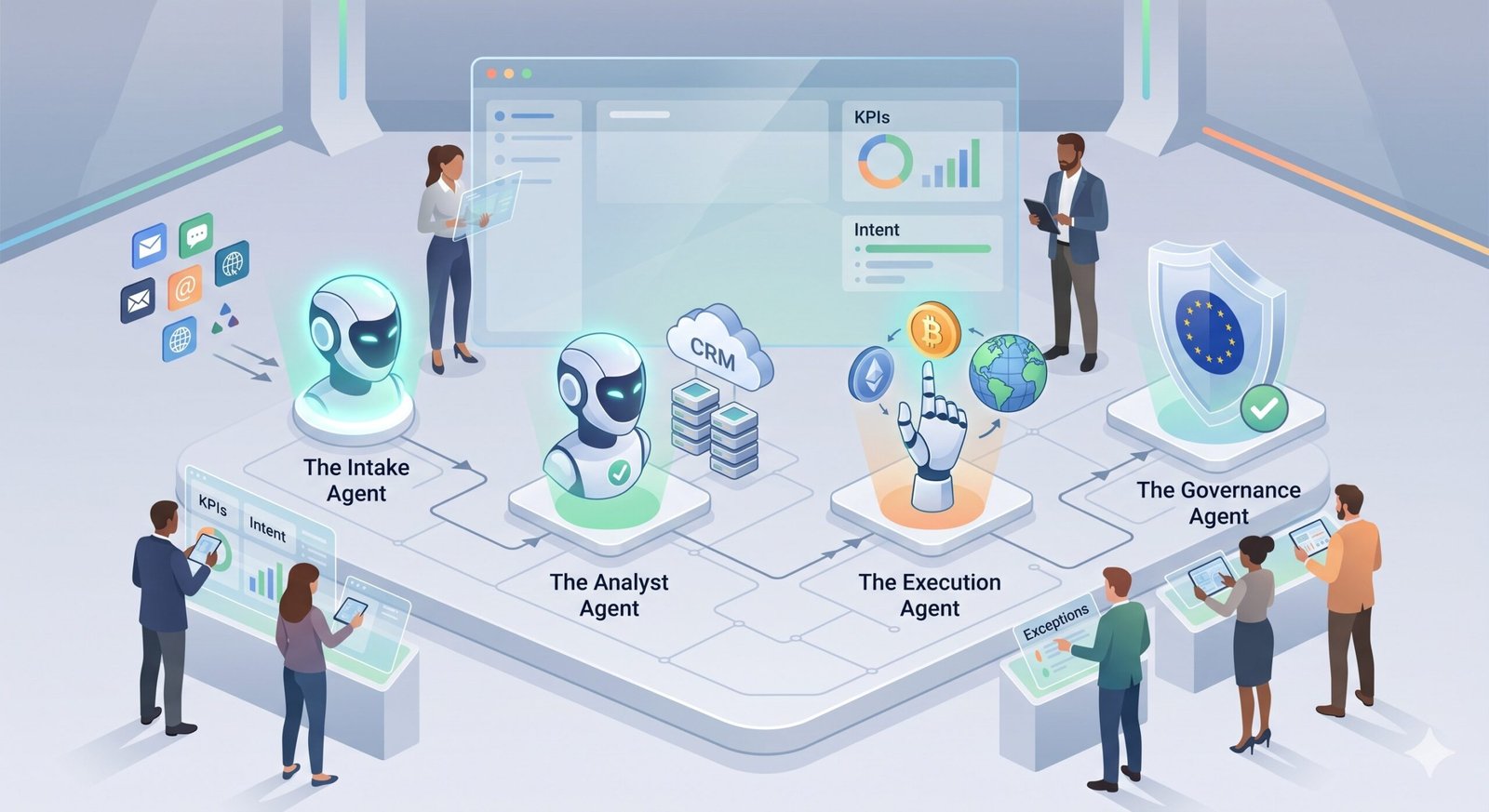
The most successful enterprises in 2026 aren’t just automating single tasks; they are building Digital Assembly Lines. This involves multiple specialized agents working in sequence:
- The Intake Agent: Monitors emails, Slack, and portals to identify incoming requests.
- The Analyst Agent: Cross-references the request against internal databases (ERP, CRM) to verify validity.
- The Execution Agent: Performs the actual transaction—be it a bank transfer, a logistics re-route, or a software provisioning.
- The Governance Agent: Audits the entire process in real-time to ensure compliance with the EU AI Act and internal security protocols.
Measurable Impact: ROI in 2026
According to recent industry reports, companies that have successfully integrated agentic orchestration are seeing a 32% reduction in operational costs. More importantly, the “half-life” of business processes has shortened. Organizations can now redesign a global workflow in hours rather than months by simply re-prompting their agentic command center.
The Role of Humans: From Doers to Orchestrators
As autonomous agents take over the “doing,” the role of the employee is evolving into that of a Value Orchestrator.
Instead of manual data entry, professionals now spend their time:
- Setting Intent: Defining the high-level business goals and KPIs the agents must hit.
- Exception Triage: Handling the 5% of complex cases where human judgment and empathy are irreplaceable.
- Strategic Optimization: Analyzing the data insights generated by agents to find new market opportunities.
Conclusion: Governance is the New Competitive Edge
In this autonomous landscape, the winners aren’t just those with the fastest AI, but those with the best Governance. As we deploy millions of digital workers, ensuring they operate within ethical and secure guardrails is the top priority for every COO in 2026.
Are you ready to transition from manual workflows to a self-optimizing business? Let’s discuss how to build your first agentic pilot.
Our greatest weakness lies in giving up. The most certain way to succeed is always to try just one more time. emotional sensation of stress from our first.